From November 27 to 30, Associate Research Professor Liang Chao led a research team from our institute to the State Field Observation and Research Station of Debris Fow in Dongchuan, Yunnan(hereinafter referred to as "Dongchuan Station"). The four-day mission included field surveys, academic exchanges, instrument maintenance, and data collection. The primary objective was to ensure the stable operation of the previously deployed dense seismic array and infrasound array observation systems, while further deepening scientific collaboration with Dongchuan Station.

Group photo of Prof. Liang Chao’s team and Station Head Song Dongri’s team during the field survey in the Jiangjia Gully watershed.
While at the station, the team conducted a comprehensive inspection of the field monitoring equipment deployed in the Jiangjia Gully watershed. Based on the status of data acquisition, adjustments were made, including the retrieval of equipment from select monitoring points. To address the fieldwork requirements of both groups, on November 29, Prof. Liang’s team formed a joint expedition with the team led by Station Head Song Dongri to carry out field operations in the rugged Xiaojianfeng area. Overcoming the challenges of high altitude and complex terrain, researchers from both sides collaborated to perform in-depth maintenance and debugging of their respective key observation instruments, thereby ensuring the continuity and accuracy of the data.
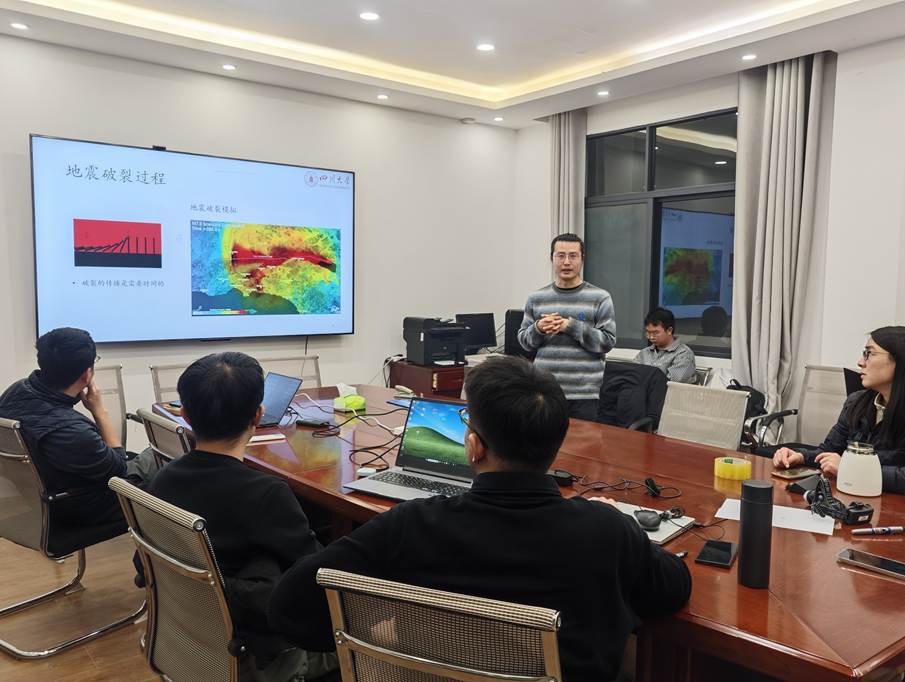
Associate Research Professor Liang Chao delivering a special report to colleagues at Dongchuan Station.
During the mission, the two teams held an academic exchange seminar. Prof. Liang delivered a special report introducing the research group's preliminary work in the field of earthquake source physics and elaborating on the vision and scientific objectives of the "seismic-acoustic" collaborative observation in the Jiangjia Gully watershed. Subsequently, Station Head Song Dongri gave a comprehensive presentation on the history of Dongchuan Station, the accumulation of long-time-series observation data, and the typical characteristics of debris flow development in the Dongchuan region. Following the reports, the two sides engaged in a lively discussion regarding the recently retrieved data, exchanging views on captured physical phenomena and potential areas for future cooperation. Additionally, at Station Head Song's invitation, Prof. Liang's team visited the station's physical modeling experiment base to gain a detailed understanding of the large-scale simulation facilities and cutting-edge monitoring technologies.
This fieldwork not only successfully accomplished the scheduled tasks of instrument maintenance and data recovery but also further solidified the cooperative relationship between our institute and Dongchuan Station through joint field operations and academic exchanges.